Equity Crowdfunding Platform: How Digital Investment Markets Are Transforming Startup Funding Worldwide
Capital used to flow through a narrow corridor of banks, venture capital firms, and a small circle of accredited investors. Today, that corridor has widened into a digital marketplace where everyday people can back startups with the same ease as shopping online. At the center of this shift stands the equity crowdfunding platform, a financial innovation that is reshaping how businesses are funded and how ownership is distributed in the modern economy.
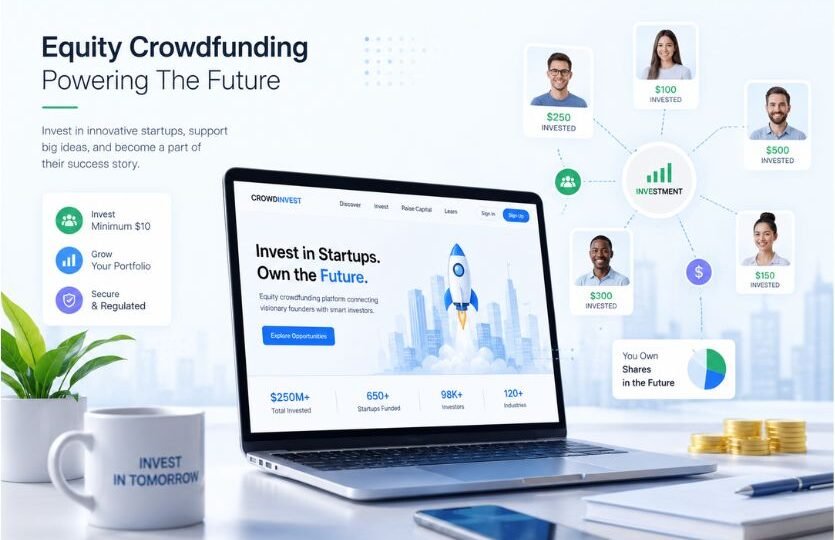
An equity crowdfunding platform is an online investment system that connects startups and private companies with a large pool of individual investors. Instead of relying on a single large investor or institution, companies raise money by offering shares to many small contributors. In return, investors receive equity ownership, meaning they become partial owners of the company and may benefit if the business grows, gets acquired, or goes public in the future.
Also Read: Innovation Roadmap: Turning Ideas into Structured Future Growth
Unlike donation-based crowdfunding where backers contribute without expecting financial returns, or reward-based crowdfunding where contributors receive products or perks, equity crowdfunding involves real financial stakes. Investors are essentially betting on the future success of a business, and their returns depend entirely on how well that business performs over time.
The rise of equity crowdfunding platforms is closely linked to changes in financial regulation and digital transformation. In the United States, the JOBS Act played a key role in opening private investments to non-accredited investors. Similar regulatory frameworks in the United Kingdom and Europe have also enabled regulated online fundraising. These legal shifts allowed platforms to legally facilitate equity investments at scale, turning what was once an exclusive investment class into a more democratized system.
At the core of these platforms is a structured digital process designed to simplify what used to be a highly complex financial transaction. A startup begins by applying to a platform, where it undergoes screening for business viability, legal compliance, and risk disclosure. If approved, the company’s fundraising campaign is published on the platform’s marketplace. Investors can then browse different opportunities, review financial documents, assess business models, and decide whether to invest.
Once an investor commits capital, the platform handles the transaction flow, compliance requirements, and equity allocation. Funds are typically held in escrow until the campaign meets its funding target or closes successfully. After completion, investors receive shares or equity-linked instruments depending on the legal structure used in that jurisdiction.
One of the most influential aspects of equity crowdfunding platforms is accessibility. Traditionally, startup investing was reserved for venture capital firms or high-net-worth individuals who could meet strict financial thresholds. Now, platforms allow investments with relatively small amounts, sometimes as low as ten dollars. This low entry barrier has significantly expanded participation, enabling retail investors to build diversified startup portfolios that were previously out of reach.
The most well-known equity crowdfunding platforms operate primarily in the United States and Europe. In the United States, platforms like Wefunder, Republic, and StartEngine have become dominant players. These platforms host thousands of startups across industries such as technology, consumer goods, healthcare, and entertainment. In the United Kingdom, Crowdcube and Seedrs have established strong reputations for regulated equity fundraising and structured investor protection.
Each platform has its own model and ecosystem. Some focus heavily on early-stage startups seeking seed capital, while others support later-stage companies raising larger funding rounds. Certain platforms also expand beyond traditional startup equity into areas such as real estate investments or blockchain-based assets, reflecting the growing diversification of alternative investment markets.
Despite their differences, all equity crowdfunding platforms share a common purpose: to connect capital seekers with capital providers through a transparent, regulated, and technology-driven environment. This structure reduces reliance on traditional intermediaries and allows companies to directly engage with their future investors, often building strong community support around their brand.
The investor experience on these platforms is designed to be educational and transparent. Campaign pages usually include detailed pitch videos, financial projections, risk disclosures, business models, and founder backgrounds. Investors can ask questions directly to founders through comment sections or live sessions, creating a more interactive investment process compared to traditional private equity deals.
However, equity crowdfunding is not without risks. Startup failure rates remain high, and many early-stage companies do not survive beyond their initial years. Unlike publicly traded stocks, shares acquired through crowdfunding are highly illiquid, meaning investors cannot easily sell or exit their positions. Returns are also uncertain and often depend on long-term outcomes such as acquisitions or IPOs, which may never occur.
Regulatory frameworks attempt to mitigate these risks by enforcing strict disclosure requirements and investment limits. In many jurisdictions, non-accredited investors are restricted in how much they can invest annually to prevent excessive financial exposure. Platforms are also required to provide standardized risk warnings and ensure that companies present accurate and transparent information.
Despite the risks, the appeal of equity crowdfunding continues to grow. One major driver is the democratization of opportunity. Investors are no longer limited to large institutional funds when it comes to accessing high-growth startups. Instead, they can participate in early-stage innovation alongside professional investors. This shift has created a sense of financial inclusion that was previously absent from private markets.
Another major factor is technological convenience. The entire investment process is digital, from browsing opportunities to signing legal documents and transferring funds. This ease of access has attracted younger investors who are more comfortable with online financial platforms and alternative investment models.
Equity crowdfunding platforms have also changed how startups think about fundraising. Instead of focusing solely on venture capital pitches, many companies now build public-facing campaigns that double as marketing tools. A successful crowdfunding campaign can generate not only capital but also brand awareness, customer acquisition, and community engagement. In some cases, investors become loyal customers, further strengthening the company’s growth potential.
Over time, the ecosystem has evolved to include secondary market innovations, where investors can trade or sell their shares before a company exits. Although still limited compared to public stock exchanges, these developments indicate a move toward more liquidity and flexibility within the sector. Some platforms are also exploring tokenization of equity, where ownership stakes are represented digitally on blockchain systems, potentially increasing transparency and transferability.
Geographically, the United States and United Kingdom remain leaders in equity crowdfunding adoption, but other regions are gradually catching up. Europe has introduced unified regulatory frameworks to encourage cross-border investment opportunities. Emerging markets are also exploring similar models, especially in regions with strong startup ecosystems but limited access to traditional venture capital.
The market size of equity crowdfunding continues to expand, with hundreds of platforms operating globally and billions of dollars raised annually. While it still represents a small portion of total startup funding compared to venture capital, its growth rate suggests increasing relevance in the broader financial landscape.
Looking ahead, the future of equity crowdfunding platforms will likely be shaped by regulatory evolution, technological innovation, and investor behavior. Artificial intelligence may play a role in evaluating startup risk profiles, while blockchain technology could enhance transparency and ownership tracking. At the same time, regulators will continue balancing innovation with investor protection to ensure market stability.
Ultimately, equity crowdfunding platforms represent a fundamental shift in how capital markets operate. They break down traditional barriers, redistribute access to investment opportunities, and create a more participatory financial system. While risks remain significant, the model continues to gain momentum as both startups and investors seek alternatives to conventional funding pathways.
What began as a niche experiment in alternative finance has now become a global movement that is redefining ownership, investment, and entrepreneurship in the digital age.